

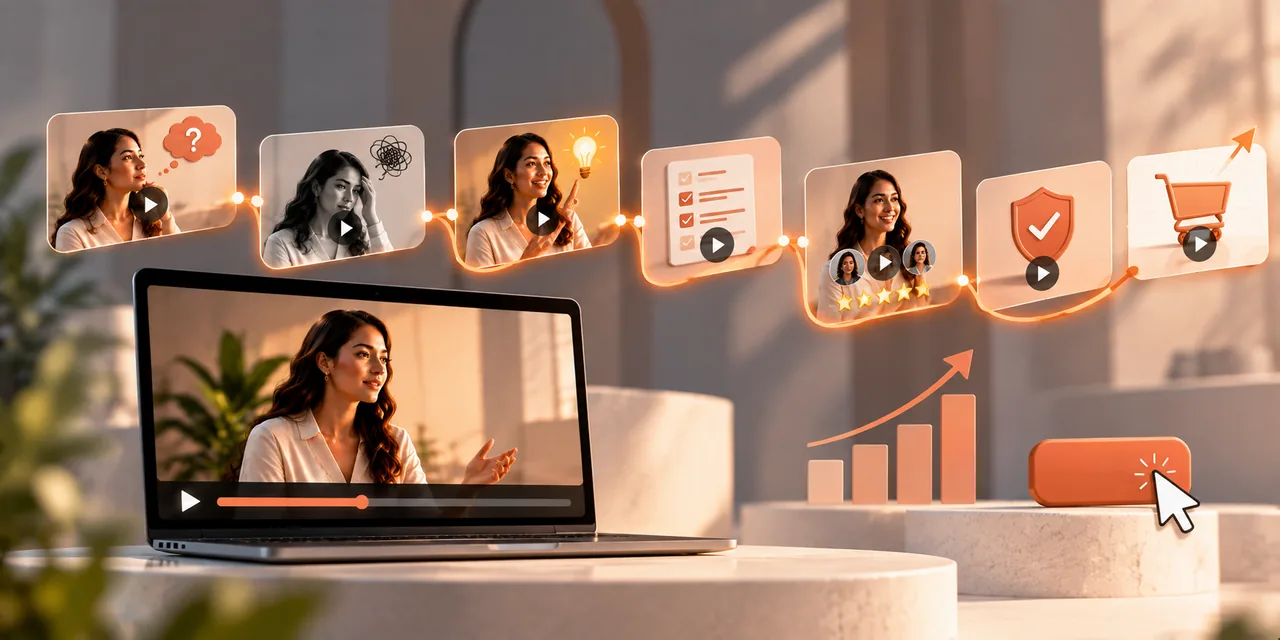
A Video Sales Letter, or VSL, is a structured sales video that guides a viewer from curiosity to purchase or booking. A VSL framework is the blueprint behind it, a proven order of parts that blends emotional storytelling with logical proof. Follow a solid framework and you turn a rambling pitch into a video that actually converts.
This guide walks through a core seven-part VSL framework, explains what each part does, and shows how to adapt the structure to your offer. If you have a product to sell and want a sales video that persuades, this is the structure to build it on.
What is a VSL framework?
A VSL framework is a repeatable script structure for a sales video. Rather than starting from a blank page each time, you follow a sequence of proven building blocks that lead the viewer step by step toward a decision.
The reason frameworks work is that persuasion follows a pattern. People need their problem named, their doubts answered, their trust earned, and their risk removed before they act. A good framework arranges these moments in the order that feels natural, so the viewer is ready to buy by the time you ask. This is the video cousin of a written sales page, and the same logic that shapes a strong sales page structure applies here.
Using a framework also frees you to focus on the message rather than the mechanics. When you already know the order of the parts, you can pour your energy into making each one strong, writing a sharper hook or finding better proof, instead of wondering what should come next. That is the quiet benefit of a proven structure: it removes the blank-page problem and lets you spend your effort where it actually changes results.
The core 7-part VSL framework
Most high-converting sales videos follow a version of the same seven-part arc. Here is each part and the job it does.
The hook, roughly the first 90 seconds. Call out your target audience, state a bold promise, and pose an enrolling question or headline that grabs attention. This opening decides whether people keep watching.
The problem and agitation. Define the core pain point in emotional terms, and explain why old solutions or common beliefs have failed. This makes the viewer feel understood and ready for a better way.
The epiphany or unique mechanism. Introduce your new approach, system, or product that changes the rules and makes success feel achievable. This is the turning point of the video.
The solution and plan. Break down how your offer works into simple, digestible steps, such as a clear three-step plan. This makes the path forward feel doable.
Social proof and credibility. Show case studies, testimonials, and results that prove your claims work for real people. This answers the viewer's natural doubt.
Risk reversal. Add a strong guarantee or warranty to remove the fear of a bad decision. This lowers the perceived risk of saying yes.
The call to action and urgency. Tell the viewer the exact next step, such as buy now or book a call, and add a genuine reason to act now.
Why does the hook matter most?
Of all seven parts, the hook carries the heaviest load, because if you lose viewers here, the rest of the framework never gets a chance to work. Most drop-off on a sales video happens in the opening seconds.
A strong hook does three things quickly. It signals who the video is for, so the right people lean in. It makes a bold, specific promise that gives them a reason to keep watching. And it raises a question they want answered, which pulls them forward. Vague, slow openings fail because they give the viewer no reason to stay. Spend a large share of your effort on the hook, since improving it often lifts results more than polishing any later section.
How do problem and agitation build desire?
The second part is where you earn the viewer's attention by showing you understand their situation better than they expected. This is not about being negative for its own sake. It is about making the problem vivid enough that the viewer wants a solution.
Naming the pain in emotional terms shows empathy and builds trust, because the viewer feels seen. Explaining why past attempts failed removes the sense that the problem is their fault, and it clears the ground for your new approach. Done well, this section makes the viewer eager for the epiphany that follows, since you have sharpened the ache your product relieves. Overdone, it feels manipulative, so keep it honest and grounded in the viewer's real experience.
How does proof turn interest into belief?
By the middle of the video, an interested viewer is also a skeptical one. They want to believe your promise, but they need evidence. This is where social proof and the unique mechanism do their work.
The unique mechanism gives them a logical reason your solution works when others did not, which satisfies the rational mind. Social proof then shows it working for people like them, which satisfies the emotional need for reassurance. Testimonials with real names and specific results are far more convincing than vague praise, so use concrete proof wherever you can. Our guide on social proof covers the formats that persuade best. Together, mechanism and proof turn a hopeful viewer into a believing one, which is what makes the eventual ask land.
How do you close a VSL effectively?
The final parts, risk reversal and the call to action, are where the sale is won or lost. Many videos build desire well and then fumble the close, leaving the viewer unsure what to do.
Risk reversal removes the last barrier by shifting the fear of a wrong decision off the viewer. A clear guarantee tells them they have little to lose, which makes saying yes feel safe. Then the call to action must be explicit and singular: state the exact next step and make it easy to take. Adding genuine urgency, such as a real deadline or limited availability, gives a reason to act now rather than later, when the video's momentum has faded. Keep the ask simple and repeat it, so a convinced viewer never has to hunt for how to buy.
How do you adapt the framework to your offer?
The seven-part framework is a guide, not a rigid script. The best VSLs adapt the structure to the offer, the audience, and the price point.
A low-cost, impulse offer can move faster and lean on a punchy hook and a quick close. A high-ticket offer needs more proof, a deeper problem section, and a stronger risk reversal, because the decision is bigger. You can also adjust length: shorter for a warm audience that already knows you, longer for a cold one that needs the full case. The key is to keep the underlying order, since it mirrors how people decide, while tuning the emphasis to your situation. Hosting the finished video on a player with a built-in call to action, like Atomic Player, lets viewers act at the peak of persuasion.
What common mistakes weaken a VSL?
Even with a solid framework, a VSL can fall flat if you make a few common mistakes. Knowing them in advance helps you avoid the traps that quietly cost sales.
The first is a weak or slow hook that fails to grab the right viewer in the opening seconds, so the rest of the video never gets watched. The second is skipping proof, or using vague testimonials, which leaves the viewer's natural skepticism unanswered. The third is a muddy call to action that asks for several things or leaves the next step unclear, so a convinced viewer does not know how to buy. The fourth is fake urgency, such as a countdown that resets, which erodes trust the moment a viewer sees through it. And the fifth is talking about yourself instead of the viewer's problem, which loses the emotional connection that drives a sale.
Most of these come down to respecting the viewer. A VSL works when it understands the viewer's problem, earns their trust honestly, and makes acting easy and safe. When a video feels pushy, vague, or self-centered, people sense it and leave. Reviewing your script against these mistakes before you record is a quick way to catch the issues that would otherwise drag your results down.
Frequently asked questions
What is a VSL framework?
It is a proven script structure for a video sales letter, a set order of parts, such as hook, problem, solution, proof, and call to action, that guides a viewer toward buying.
How long should a VSL be?
It depends on the offer and audience. Warm audiences and simple offers suit shorter videos, while cold audiences and high-ticket offers usually need more time to build the case.
What is the most important part of a VSL?
The hook, because most viewers who leave do so in the opening seconds. A strong hook keeps people watching long enough for the rest of the framework to work.
Do I need testimonials in a VSL?
Proof is one of the most persuasive parts of a sales video. Real testimonials and case studies answer the viewer's doubt and make your promise believable.
Where should I host my VSL?
Host it on a reliable player that supports a clear in-video call to action, so it plays smoothly and lets viewers act at the moment they are convinced.
Structure a sales video that converts
A VSL framework turns a sales video from a hopeful pitch into a persuasive sequence. Hook hard, name the problem, prove your case, remove the risk, and ask clearly.
Start your trial and host videos that play smoothly and keep viewers watching, no code required.
If you read nothing else
- A VSL framework sequences hook, problem, mechanism, proof, offer, and CTA so the pitch is persuasive not random.
- Pick the framework that matches ticket size and awareness — then edit against the retention curve.
- Host on a player that supports timed in-video CTAs so the close is not left to chance.
- Test frameworks as systems: change one block at a time and read play rate, retention, and sales together.
Atomicat Team
The team behind AtomicPlayer — writing about video conversion, retention, and the infrastructure that makes both measurable.


