

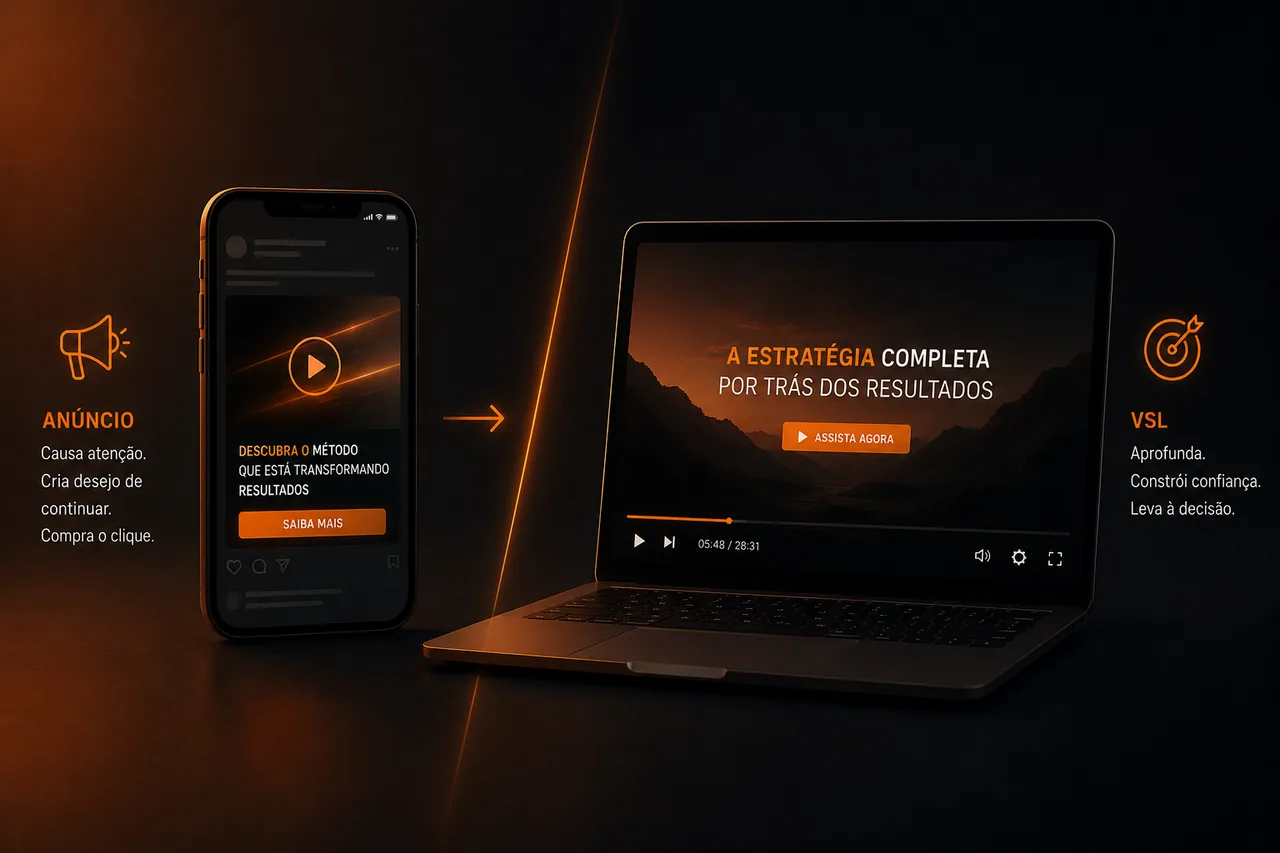
Ads and VSLs compete for different kinds of attention. In the feed, the person did not ask for your content and may leave in a second. On the page, they already clicked and will invest more time, but they need to confirm quickly that the promise still makes sense.
That is why cutting the first 30 seconds of a VSL and calling it a creative usually produces a slow piece. The reverse also happens: stretching an aggressive hook ad into a VSL creates depth without substance.
The ad buys the next click
The creative must stop the scroll, qualify the problem, and create desire to continue. Hook rate and CTR help measure that job.
It does not need to resolve every objection.
The VSL builds the decision
The VSL can develop lead, mechanism, proof, offer, and CTA with more room. Play rate and retention show whether the page turns a click into attention.
The audience arrived with a promise from the ad. The VSL should acknowledge it early.
The language can be the same, the pace cannot
Angle, big idea, and mechanism can travel between pieces. Pace and depth need to change.
Think in families of creatives and VSLs, not one file cut any which way.
Test the bridge between ad and video
Compare creatives by the behavior they create inside the VSL. A lower-CTR ad may bring an audience that watches more and buys more.
That read avoids optimizing only for cheap clicks.
CPA shows the quality of the set
If hook rate rises but CPA worsens, attention may be unqualified. If play rate drops on a specific campaign, the promise may be misaligned.
Use data from the full journey to decide which hooks to scale.
How to put this into practice
Mark on your script the moments that serve a function: hook, lead, mechanism, proof, offer, and CTA. Then overlay those markers on the video curve. This read is far more useful than debating edits by taste, because it shows exactly which part of the message aligns with a drop, rewatch, or move toward purchase.
Also build a library of learnings by offer. Save hooks, leads, big ideas, proof sections, and CTAs that performed well, always with traffic, ticket, and period context. An internal swipe file with data beats copying a foreign-market VSL without knowing if it worked for the same audience.
Metrics worth tracking alongside the decision
Play rate, first-minute retention, retention to price, CTA clicks, and conversion form a baseline read. For paid media, also connect hook rate, CPA, and ROAS. When possible, segment by creative, device, and source. The overall average can hide a VSL that excels for one audience and falls flat for another.
Conclusion
Ads and VSLs share strategy, not necessarily editing. Each piece must respect the attention state in which it is consumed.
The best combination is one where the hook attracts the right person and the VSL keeps the promise through purchase.
Frequently asked questions
Yes, as long as the clip is re-edited for feed pace and context.
Hook rate, CTR, and CPA, always looking at traffic quality after the click.
Play rate, retention, CTA clicks, and conversion.
If you read nothing else
- Ads interrupt; sales pages convert — different contexts need different opens.
- Ad creative should earn the click; page video should earn the purchase.
- Reusing one file usually weakens both hook rate and close rate.
- Build a creative-to-page system, not a single hero asset.
Atomicat Team
The team behind AtomicPlayer — writing about video conversion, retention, and the infrastructure that makes both measurable.


