

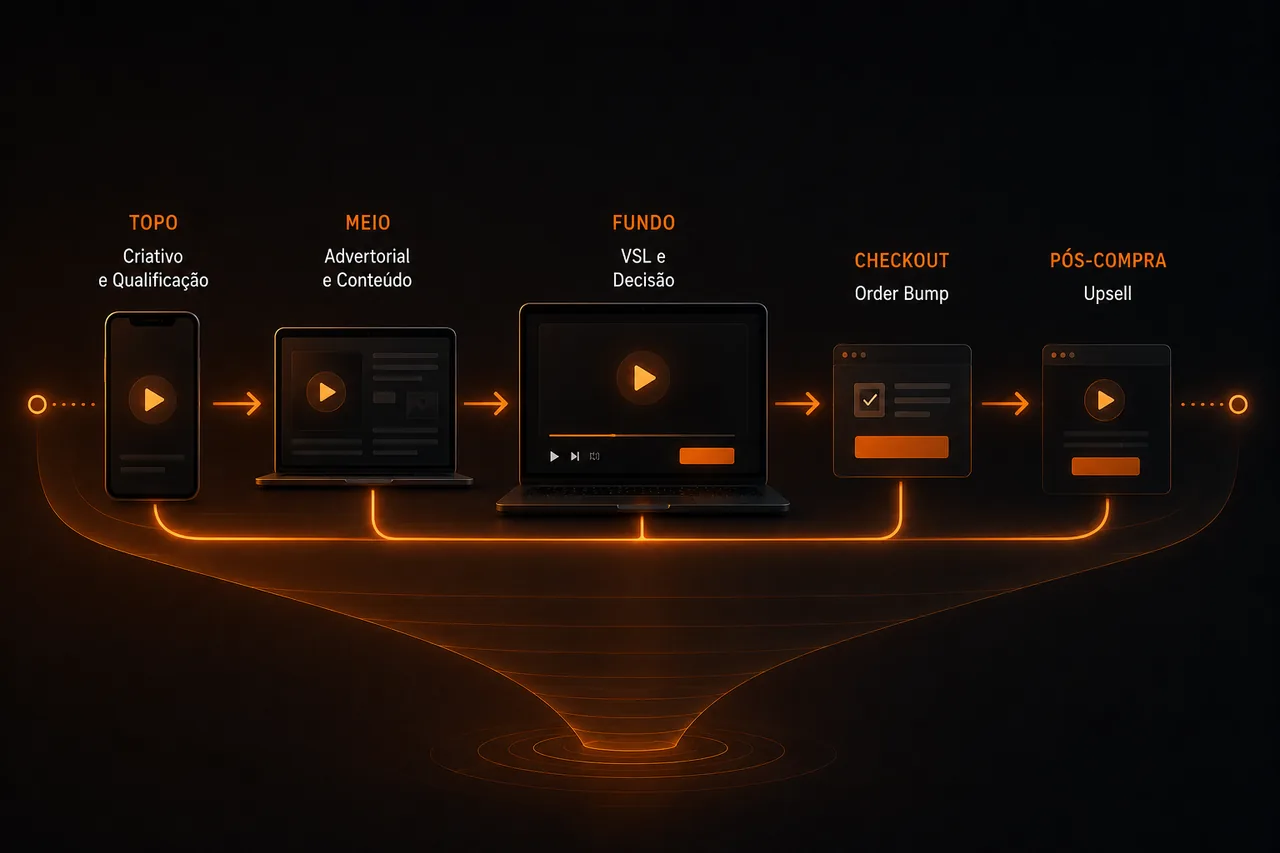
Video does not have to exist only on the final sales page. A funnel can use short creatives to generate attention, advertorial or content to build awareness, a VSL to sell the main offer, and upsell videos to increase AOV after purchase.
The job changes at each stage. The mistake is reusing the same 20-minute video at every point and expecting context to do the work alone.
Top: hook and qualification
Top-of-funnel creatives need to win attention and qualify the problem. Hook rate, CTR, and click quality are early metrics.
Do not try to explain the whole offer. The goal is to earn the next step with the right person.
Middle: advertorial and content
An advertorial, case study, or educational video can raise awareness of the mechanism before the VSL.
This stage helps when the offer needs context or when cold traffic rejects a direct sale.
Bottom: VSL and decision
In the VSL, lead, mechanism, proof, offer, and CTA form the main argument. Track play rate, retention, price exposure, and conversion.
The video should align with the page and the checkout.
Checkout: order bump
An order bump is a small decision before purchase, ideal for a simple add-on. It increases AOV without requiring a second complex funnel.
Test relevance and impact on checkout conversion.
Post-purchase: upsell
An upsell can have its own mini VSL, because the person already bought and is in a different mental state.
Measure take rate, AOV, refunds, and net revenue. An aggressive upsell is not worth it if it hurts retention or chargebacks.
Read the funnel by economics
ROAS, CPA, AOV, and margin connect each video to the business. A stage may convert less and still improve overall economics by raising quality or ticket.
Avoid optimizing each video in isolation.
How to put this into practice
Mark on your script the moments that serve a function: hook, lead, mechanism, proof, offer, and CTA. Then overlay those markers on the video curve. This read is far more useful than debating edits by taste, because it shows exactly which part of the message aligns with a drop, rewatch, or move toward purchase.
Also build a library of learnings by offer. Save hooks, leads, big ideas, proof sections, and CTAs that performed well, always with traffic, ticket, and period context. An internal swipe file with data beats copying a foreign-market VSL without knowing if it worked for the same audience.
Metrics worth tracking alongside the decision
Play rate, first-minute retention, retention to price, CTA clicks, and conversion form a baseline read. For paid media, also connect hook rate, CPA, and ROAS. When possible, segment by creative, device, and source. The overall average can hide a VSL that excels for one audience and falls flat for another.
Conclusion
A video funnel works when each piece has a clear job and its own context. Creative, advertorial, VSL, order bump, and upsell can form a coherent sequence.
Measure attention at each stage, but decide by the economics of the whole funnel.
Frequently asked questions
No. Use a VSL where a full argument helps the decision.
They can increase when relevant and they do not create excessive friction.
Net revenue, CPA, AOV, and ROAS, supported by play rate and retention.
If you read nothing else
- Each funnel stage asks a different job of video — one VSL cannot do all of them.
- Cold traffic needs hooks; warm traffic needs mechanism and proof.
- Match CTA intensity to awareness — do not pitch before the viewer is ready.
- Measure stage-by-stage, not just final conversion.
Atomicat Team
The team behind AtomicPlayer — writing about video conversion, retention, and the infrastructure that makes both measurable.


