

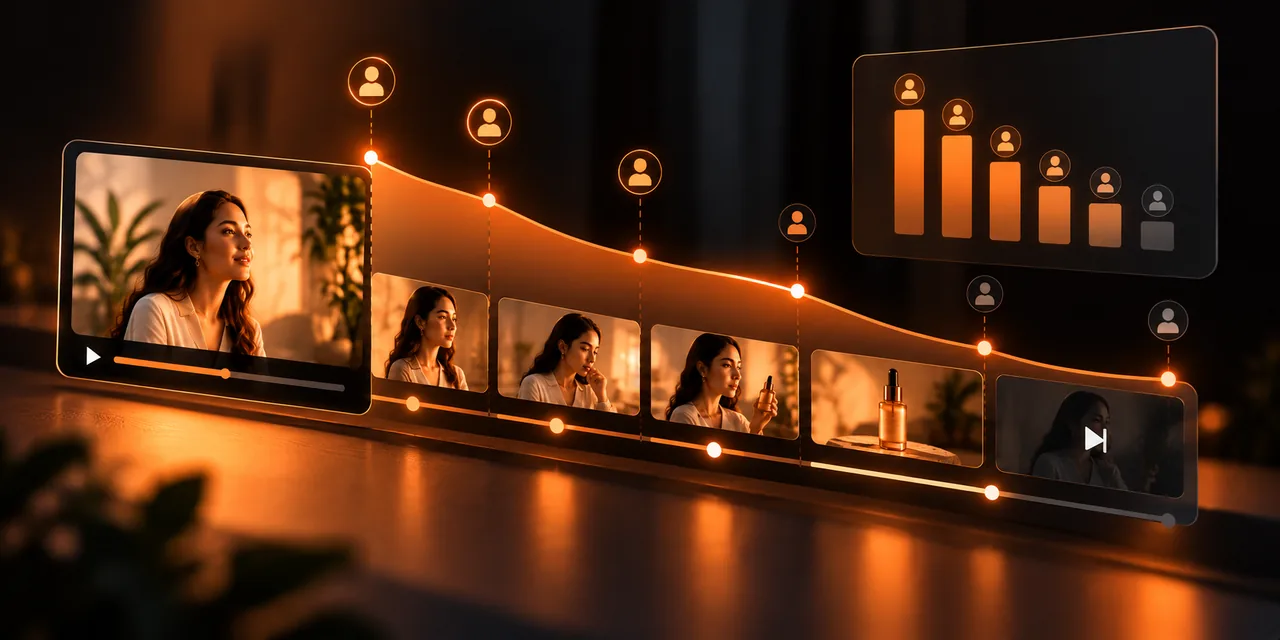
Video completion rate, often shortened to VCR, is the percentage of viewers who watch your video all the way to the end. You calculate it by dividing completed views by total video starts, then multiplying by 100. It is one of the clearest signals of whether your content holds attention.
This guide explains what video completion rate is, how to calculate it, what a good rate looks like by format, and the practical steps that lift it. If people start your videos but do not finish them, this is the number that shows the problem and points you toward the fix.
What is video completion rate in simple terms?
Video completion rate measures how many of the people who pressed play actually stayed until the final frame. A high rate means your content kept people engaged, while a low rate means they lost interest and left partway through.
The metric matters because a start is easy to earn and a finish is not. Plenty of videos get clicks, but the ones that get watched to the end are the ones delivering real value. That is why completion rate is such an honest measure. It strips away vanity and tells you whether your video was worth people's time, which is exactly what you need to know if you are using video to sell or teach.
How do you calculate video completion rate?
The formula is straightforward, and you only need two numbers to work it out.
Take the number of completed views and divide it by the total number of video starts, then multiply by 100. As an example, if 1,000 people start your video and 600 watch to the end, your completion rate is 60 percent. Most video platforms report this figure for you, but knowing the formula helps you sense-check the numbers and understand what drives them.
It is worth deciding what counts as a start and a completion for your purposes. Some platforms count a view after a few seconds, and some count completion at 95 percent rather than the very last frame. As long as you stay consistent, the trend over time tells you what you need to know.
Completion rate is also worth reading next to your raw view count, because the two together tell a fuller story. A video with many starts but a low completion rate is reaching people who are not the right fit, or is losing them with a weak opening. A video with fewer starts but a high completion rate is connecting deeply with a smaller, well-matched audience. Neither number alone gives the full picture, so looking at both keeps you from celebrating big view counts that hide poor retention, or dismissing modest ones that actually engage people well.
What is a good video completion rate?
Like most metrics, a good completion rate depends on context, especially the length and format of your video. Shorter videos tend to hold people better, so their benchmarks are higher.
As a rough guide, a completion rate in the range of 50 to 70 percent is often considered healthy, while short clips under fifteen seconds may aim for 80 to 90 percent. Format shifts the picture too. Short-form content on platforms like Reels and Shorts often sees higher completion, long-form videos naturally see lower rates because there is more to sit through, and non-skippable ads can run very high simply because viewers cannot leave. Rather than fixating on someone else's number, watch your own rate over time and work to beat it.
Why does video completion rate matter?
Completion rate is more than a scorecard. It affects how your videos perform and what you learn from them.
It shows engagement. A high rate is direct evidence that your content holds attention, which is the foundation of any video goal.
It signals to algorithms. Many platforms promote videos that people finish, so a strong completion rate can win you more reach without extra spend.
It guides your content. Watching where people drop off tells you which parts lose them, so you can cut or rework those moments in future videos.
For marketers, there is a further link. A viewer who finishes your video is far more likely to see your call to action and act on it, so completion rate feeds directly into results like leads and sales.
Where do viewers drop off, and why?
To improve completion, you first need to understand where and why people leave. Most drop-off follows predictable patterns.
The biggest loss usually happens in the first few seconds, when viewers decide whether the video is for them. A slow or unclear opening loses people before they give it a chance, which is why the opening deserves more attention than almost any other part of the video. After that, drop-off tends to cluster around dull stretches, overlong explanations, or moments where the video stops delivering on its promise. A retention graph, which most platforms provide, shows these drop-off points as dips, and reading it is the fastest way to see exactly where your video loses its grip. Once you know where people leave, you know where to focus.
How do you improve your video completion rate?
Lifting completion is mostly about respecting the viewer's attention and time. A handful of reliable moves make a real difference.
Hook early. Capture interest in the first three to five seconds with a clear promise or an intriguing opening, since that window decides whether people stay.
Cut the fluff. Keep the video as concise as the message allows. Long, padded sections are where attention leaks away.
Match length to platform. A length that works on YouTube may be far too long for a feed video, so tailor the runtime to where it will be watched.
Keep the pace moving. Vary your visuals, trim dead air, and get to the point. A brisk pace holds attention better than a slow one.
Deliver on the promise. Make sure the video gives what the title or thumbnail suggested, or viewers will feel misled and leave.
Playback quality matters too. A video that stalls or buffers drives people away no matter how good the content is, which is why smooth streaming supports completion. Hosting on a player built for reliable playback, like Atomic Player, removes that technical drag on your numbers.
How does completion rate connect to conversions?
Completion rate and conversion are closely linked, because the end of your video is usually where you ask for the action. If few people reach the end, few people see the ask.
This is why improving completion often lifts results across the board. More viewers reaching your call to action means more clicks, sign-ups, or sales from the same number of starts. It also pays to place a clear call to action before the very end, so viewers who are convinced can act without watching every last second. Pairing a strong completion rate with a well-placed call to action, and measuring the outcome through your video conversion rate, turns attention into business results.
How does completion rate differ by platform?
Completion rate does not mean the same thing everywhere, because each platform shows video differently and counts views differently. Reading your number in the right context keeps you from drawing the wrong conclusion.
On short-form feeds like Reels, Shorts, and TikTok, videos are brief and often loop, so completion rates tend to run high, and a strong number there is expected rather than exceptional. On long-form platforms like YouTube, viewers face more content to sit through, so a lower completion rate is normal and still healthy. On connected TV and non-skippable ad placements, completion can look very high simply because viewers cannot leave, which says more about the format than your content. Comparing your YouTube completion rate to your TikTok completion rate is comparing two different things, so track each platform against itself.
This is why a single benchmark can mislead. What matters is whether your completion rate on a given platform is improving over time, and how it compares with your own past videos on that same platform. Judge each channel by its own standard, and you will read the numbers correctly.
Frequently asked questions
What is video completion rate?
It is the percentage of viewers who watch a video from start to finish, calculated as completed views divided by total starts, multiplied by 100.
How do you calculate video completion rate?
Divide the number of completed views by the total number of video starts, then multiply by 100. For example, 600 completions from 1,000 starts is a 60 percent rate.
What is a good video completion rate?
It varies by length and format, but 50 to 70 percent is often healthy, and short clips may aim for 80 to 90 percent. Your own improving trend is the best benchmark.
Why is my completion rate low?
Common causes are a weak opening, an overlong or slow video, content that does not match the title, or playback that buffers. A retention graph shows where people leave.
How can I improve my completion rate?
Hook viewers early, cut filler, match the length to the platform, keep the pace moving, deliver on your promise, and make sure the video plays smoothly.
Keep viewers watching to the end
Video completion rate tells you whether your content earns the attention it asks for. Hook people fast, keep it tight, deliver on the promise, read your retention graph, and make sure it plays without stalling.
Start your trial and host videos that play smoothly and keep viewers watching, no code required.
If you read nothing else
- Video completion rate (VCR) is completed views divided by plays — a direct read on whether content earns attention.
- Benchmarks vary by length and format; compare like-for-like, not against unrelated clips.
- Improve VCR with a strong hook, tighter edits, platform-fit length, and delivery that does not buffer.
- Pair completion with conversion metrics so finishing the video still leads to the action you want.
Atomicat Team
The team behind AtomicPlayer — writing about video conversion, retention, and the infrastructure that makes both measurable.


