

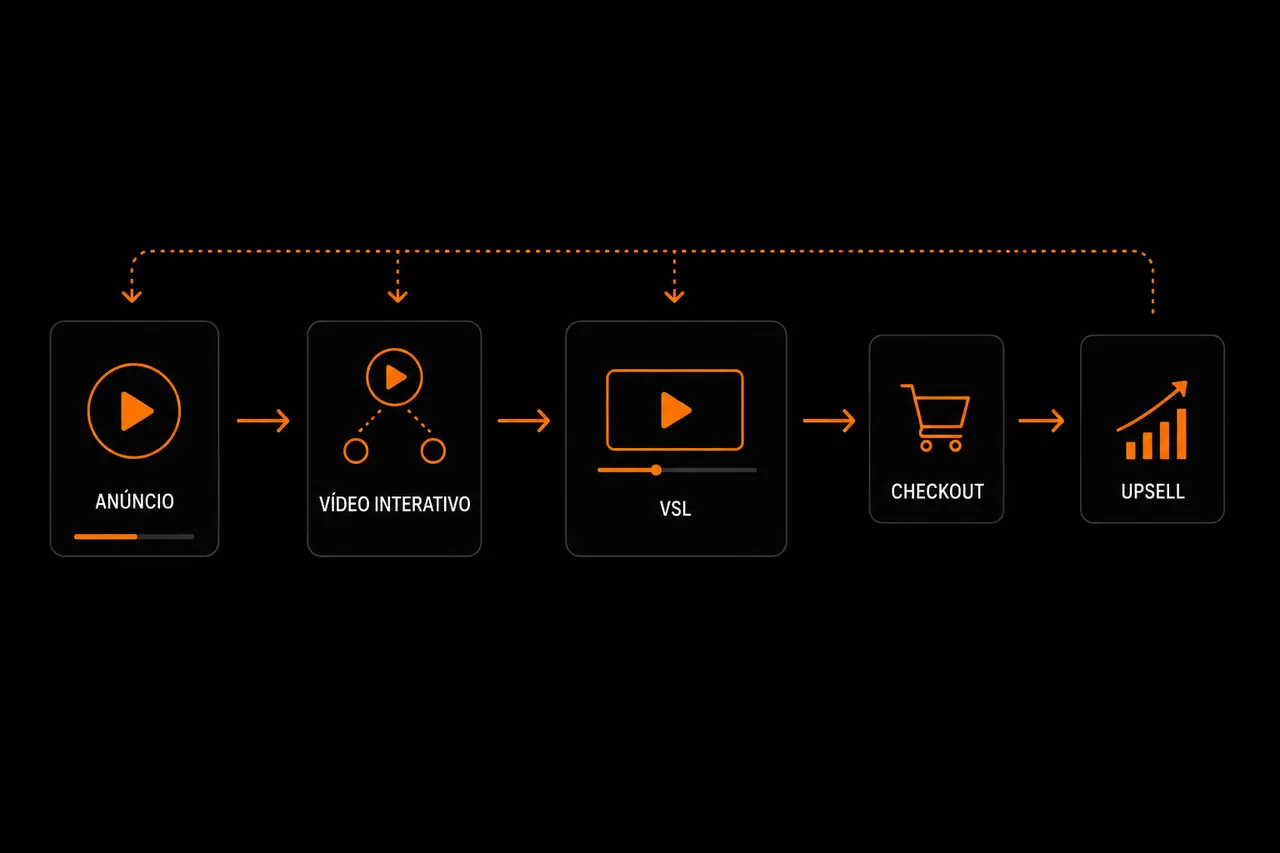
Not every visitor needs to watch the same sequence. Interactive video lets you create decisions inside the experience: choose profile, problem, goal, or next content. That can reduce time to relevant information and increase qualification.
The advantage is not putting buttons on video for novelty. It is using each choice as a signal of intent and guiding the user to a more suitable message.
Start with a decision that actually changes the conversation
Asking "what is your goal?" only matters if the answer changes content, CTA, or offer.
Avoid huge trees that feel like a disguised form. Two or three clear routes can already generate learning.
Use interaction to qualify
One route can send beginners to mechanism explanation and advanced users to a demo or case study.
That reduces repetition and keeps relevance.
CTA can appear at the right moment
Interactions let you show a CTA after a specific answer or section, instead of using the same timing for everyone.
Measure exposure, clicks, and conversion by route.
Preserve end-to-end analytics
Each choice should generate an identifiable event and follow through to checkout or signup.
Without that connection, you know someone clicked inside the video, but not whether the path improved revenue.
Watch out for complexity
More paths mean more copy, QA, and maintenance. Start with the segmentation that has the biggest intent difference.
If two routes end with the same message, they may not need to exist separately.
How to put this into practice
Mark on your script the moments that serve a function: hook, lead, mechanism, proof, offer, and CTA. Then overlay those markers on the video curve. This read is far more useful than debating edits by taste, because it shows exactly which part of the message aligns with a drop, rewatch, or move toward purchase.
Also build a library of learnings by offer. Save hooks, leads, big ideas, proof sections, and CTAs that performed well, always with traffic, ticket, and period context. An internal swipe file with data beats copying a foreign-market VSL without knowing if it worked for the same audience.
Metrics worth tracking alongside the decision
Play rate, first-minute retention, retention to price, CTA clicks, and conversion form a baseline read. For paid media, also connect hook rate, CPA, and ROAS. When possible, segment by creative, device, and source. The overall average can hide a VSL that excels for one audience and falls flat for another.
Conclusion
Interactive video works best when it simplifies the journey and improves relevance. The interaction should represent a real decision, not a visual effect.
Start with few routes, connect events to the final outcome, and expand only where data justify it.
Frequently asked questions
Not necessarily. It can segment before, inside, or after a VSL.
Start with the minimum that represents real intent differences.
Choices, retention by route, CTA clicks, conversion, and revenue by path.
If you read nothing else
- Interactive video fits mixed audiences better than one linear argument.
- Branching works when segments have different objections or awareness levels.
- Keep paths short — interactivity is not an excuse for longer videos.
- Measure which branches convert, not just total plays.
Atomicat Team
The team behind AtomicPlayer — writing about video conversion, retention, and the infrastructure that makes both measurable.


