

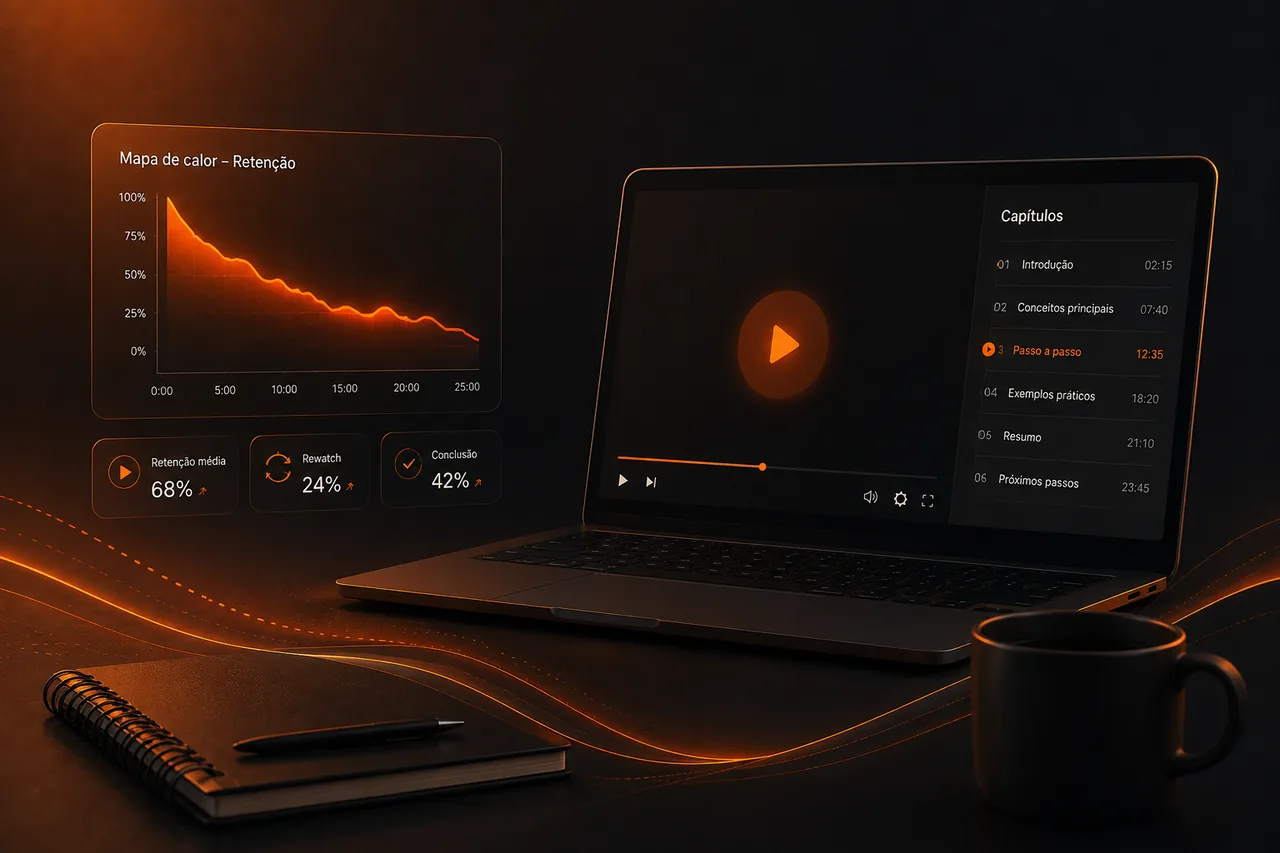
A video lesson does not need TikTok pacing, but it must respect attention. When the student knows where they are, why that section matters, and how much is left to finish, the experience feels lighter. Chapters, examples, and functional editing help more than random cuts every two seconds.
The best module length comes from the learning objective. A seven-minute lesson can feel long if it repeats concepts. A forty-minute one can work when it guides a complex execution clearly.
One lesson, one main outcome
Define what the student should know or do when finished. If there are three independent outcomes, consider splitting into smaller lessons.
This improves navigation, search, and later review.
Chapters reduce friction without killing consumption
Chapters let students jump to a specific question and return to the important point. That is useful in reference content.
Do not treat every skip as abandonment. In analytics, navigation context matters.
Rewatch can signal value or confusion
When many people return to the same section, it may be because it is important or because it was hard. Compare with comments, playback speed, and forward skips.
Heatmaps help identify these zones without relying on opinion.
Pace comes from clarity
Replace generic examples with demonstration, remove useless pauses, and signal transitions. Editing should support understanding, not draw more attention than the content.
Dense slides read aloud usually hurt the experience.
Use analytics to revise the course
Compare retention by lesson, module completion, and rewatch points. Start with lessons that have the highest volume and worst drop.
A small improvement in core lessons can increase activation and reduce support more than producing new modules.
How to put this into practice
Mark on your script the moments that serve a function: hook, lead, mechanism, proof, offer, and CTA. Then overlay those markers on the video curve. This read is far more useful than debating edits by taste, because it shows exactly which part of the message aligns with a drop, rewatch, or move toward purchase.
Also build a library of learnings by offer. Save hooks, leads, big ideas, proof sections, and CTAs that performed well, always with traffic, ticket, and period context. An internal swipe file with data beats copying a foreign-market VSL without knowing if it worked for the same audience.
Metrics worth tracking alongside the decision
Play rate, first-minute retention, retention to price, CTA clicks, and conversion form a baseline read. For paid media, also connect hook rate, CPA, and ROAS. When possible, segment by creative, device, and source. The overall average can hide a VSL that excels for one audience and falls flat for another.
Conclusion
A video lesson that retains organizes attention. Duration, chapters, and pace should serve learning, not an aesthetic rule.
Use heatmaps and behavior to find what deserves a cut, more explanation, or a split.
Frequently asked questions
The length needed to deliver one clear objective without repetition. There is no universal number.
They can increase useful navigation. In educational content, jumping to the right point is not necessarily bad.
Often yes, but it can also signal confusion. Read it together with comments and other data.
If you read nothing else
- Retention in video lessons is a pacing problem before it is a content problem.
- Chapters give students control and improve completion on long modules.
- Module length should match cognitive load — not arbitrary hour marks.
- Use analytics to find where students pause, skip, and drop off.
Atomicat Team
The team behind AtomicPlayer — writing about video conversion, retention, and the infrastructure that makes both measurable.


