

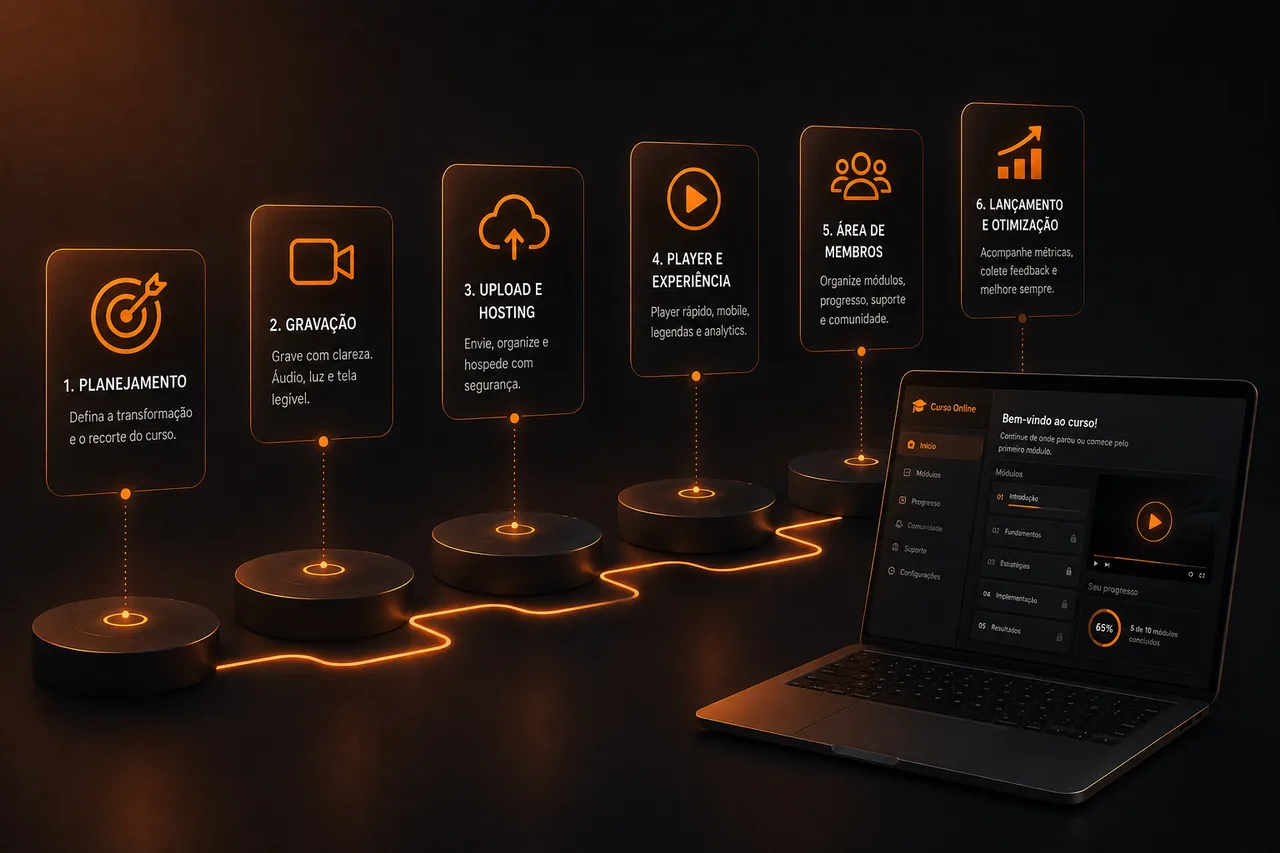
Creating an online course does not start with choosing a camera. It starts by defining transformation, sequence, and proof of progress. Recording comes next, and the members area must turn that content into an experience the student can consume without hunting for instructions on every screen.
A lean operation can launch with simple equipment and improve production over time. What cannot be missing is curriculum clarity, understandable audio, stable video hosting, and a clear path to the first result.
Define the transformation and the scope
Write who enters, with what problem, and what they can do at the end. Avoid a course that promises to teach "everything."
A clear scope makes copy, modules, and support expectations easier.
Design modules by decision or execution
Organize the sequence into steps the student can complete. Each module should unlock the next.
Include checkpoints, templates, or tasks when they speed up application.
Record for clarity, not cinema
Prioritize audio, enough light, and a readable screen. In tutorials, a clean screen capture beats an expensive set.
Record in blocks to make updates easier. Digital courses age, and small parts are easier to replace.
Choose hosting and player with experience in mind
Consider load time, mobile, captions, domain control, white label, and analytics.
The player is where the student spends time. If it stalls, the whole perception of course quality drops.
Build onboarding to first value
The home page should say where to start, how to get help, and which action to complete first.
Measure activation, progress, and lessons with drop-off. Student retention starts before the second module.
How to put this into practice
Mark on your script the moments that serve a function: hook, lead, mechanism, proof, offer, and CTA. Then overlay those markers on the video curve. This read is far more useful than debating edits by taste, because it shows exactly which part of the message aligns with a drop, rewatch, or move toward purchase.
Also build a library of learnings by offer. Save hooks, leads, big ideas, proof sections, and CTAs that performed well, always with traffic, ticket, and period context. An internal swipe file with data beats copying a foreign-market VSL without knowing if it worked for the same audience.
Metrics worth tracking alongside the decision
Play rate, first-minute retention, retention to price, CTA clicks, and conversion form a baseline read. For paid media, also connect hook rate, CPA, and ROAS. When possible, segment by creative, device, and source. The overall average can hide a VSL that excels for one audience and falls flat for another.
Conclusion
A good online course combines curriculum, functional production, and stable delivery. Do not let technology hide a confusing learning sequence.
Start with the minimum that delivers value and use analytics and feedback to improve the parts that actually affect progress.
Frequently asked questions
No. Clear audio, reasonable light, and well-structured content matter more at the start.
Choose by level of control, analytics, branding, mobile, and volume needed.
Activation, module completion, retention, rewatch, support, and student outcome.
If you read nothing else
- Outline before you record — structure reduces reshoots and member confusion.
- Record for the members area player you will actually use.
- Launch with a minimum viable curriculum; expand from completion data.
- The members area experience is part of the product, not an afterthought.
Atomicat Team
The team behind AtomicPlayer — writing about video conversion, retention, and the infrastructure that makes both measurable.


